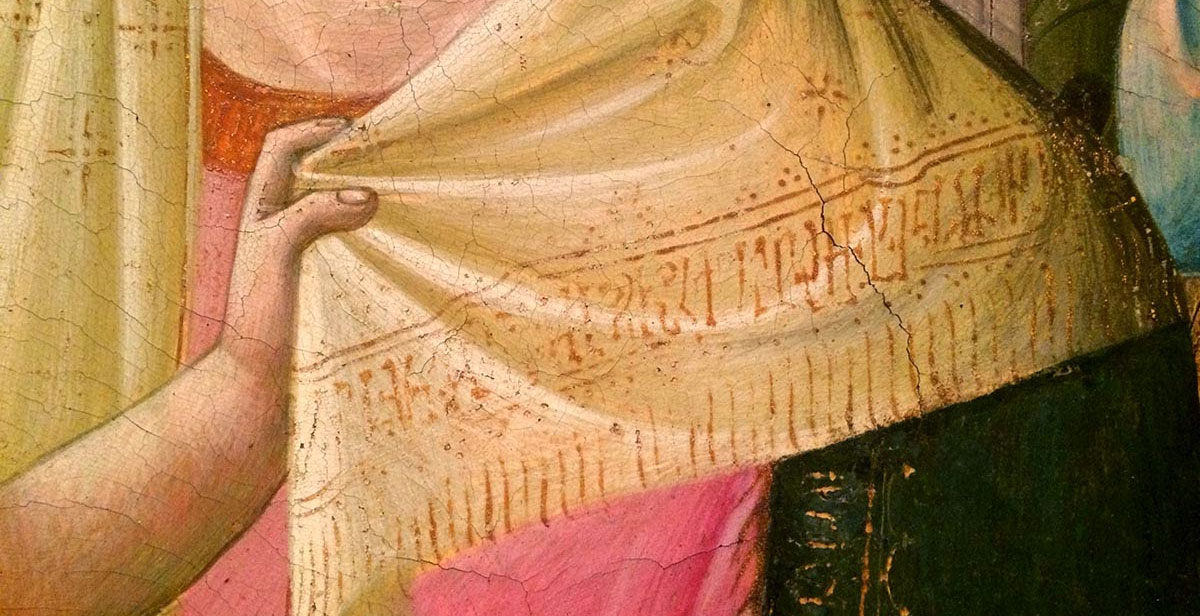
Pseudo-Scripts?

Rethinking an Underexplored Script-Image Phenomenon

Thematic call for Epigraphy, Graffiti, Iconography (EGI), an Open-Access, Peer-Reviewed Journal.
Co-editor: Anna Elisabeth Krebs-Bendszus, Institute for Art History, University of Bonn, Germany

Abstract (seminar) until 15 of May 2026.
Full paper (publishing) until the end of August 2026.
Publication of the Issue: November 2026.

Online Seminar September / October (to be announced)


Submissions should be made through the EGI journal publishing platform.
Please indicate the thematic call you are submitting to in the “Comments for the Editor” field.


Unreadable forms of writing appear in a wide range of visual and material contexts in the premodern world. The phenomenon is particularly prominent in European painting of the 13th to 16th centuries, where numerous script motifs occur that clearly imitate writing but cannot be assigned to any readable language. In art-historical scholarship, such forms are commonly grouped under the umbrella term “pseudo-script” In recent years, scholarly interest in these phenomena has grown considerably. At the same time, however, their description and interpretation have revealed significant terminological and methodological challenges.

The concept of “pseudo-script” is often used rather loosely in the literature. Typically, scholars distinguish only between correct, means readable writing and unreadable “pseudo-script” (e.g., Dietmann 2021; Rehm/Simonis 2019; Ross 2014; Boockmann 2013). Such a binary distinction, however, fails to capture the complexity of the phenomenon. As Alexander Nagel and James Elkins have noted, the term covers a wide and heterogeneous range of practices that appear in different contexts and serve different purposes (Nagel 2011; Elkins 1999). Its broad application risks obscuring the diversity of forms and intentions involved.

In general terms, pseudo-scripts can be described as invented or distorted letterforms that follow the formal conventions of writing. These may include the arrangement of distinct characters or indications of word separation. Their primary aim is not readability but the visual evocation of writing. In many cases, the characters imitate recognizable alphabets such as Hebrew, Greek, or Arabic, giving rise to forms that may be described as pseudo-Hebrew, pseudo-Greek, or pseudo-Arabic. Often, correct letters appear alongside invented signs or elements from different alphabets are combined. The resulting script thus functions primarily as a visual marker of language and literacy rather than as a carrier of legible textual content (Birk 2013).

These observations raise the question of whether a more differentiated terminology might help clarify the phenomenon. In the case of Hebrew, where the diversity of forms and uses in panel painting of the 15th century becomes particularly evident, it is possible to propose a preliminary heuristic distinction that may also be applicable to other writing systems such as Greek or Arabic, though it still requires broader critical evaluation. One might distinguish between Hebrew, Hebraizing, and Pseudo-Hebrew. Hebrew would refer to correctly written and readable Hebrew texts. Hebraizing would describe forms that imitate Hebrew letterforms but are not necessarily fully accurate. Pseudo-Hebrew, by contrast, would designate entirely invented or heavily distorted character sequences that merely evoke the appearance of Hebrew writing. Such distinctions could help refine the terminology currently subsumed under the general category of “pseudo-script” (Krebs 2026).

Geographical and cultural contexts also shape the use of such script imitations. Recent research suggests that Italian painters frequently employed Arabizing or pseudo-Arabic forms, while artists north of the Alps increasingly used Latin, Greek, or Hebraizing scripts from the fourteenth century onward. While Arabizing inscriptions in Italian art has received considerable scholarly attention (e.g. Napolitano 2019; Dolezalek 2017), a broader comparative overview of other script traditions and of their functions in different pictorial contexts has yet to be undertaken. Significant research gaps also persist regarding other writing systems and visual strategies. The use of runic forms, for example, has hardly been examined systematically (Ganz 2018).

This special issue seeks to address pseudo-scripts as a complex and understudied script-image phenomenon from an explicitly interdisciplinary perspective. It aims to explore the relationship between writing and image, readability and visuality, and the cultural meanings attached to the imitation of scripts. In addition to art-historical case studies, contributions from related disciplines are strongly encouraged, including: epigraphy, palaeography, manuscript studies, archaeology and medieval studies; as well as religious and literary studies, linguistics, semiotics, and the digital humanities.

We particularly welcome contributions that address questions such as:

  • What terminological and methodological challenges arise when studying pseudo-scripts, and how might they be addressed?
  • How can different forms of unreadable or pseudo-writing be categorized and distinguished?
  • In which media contexts do pseudo-scripts occur (e.g., painting, manuscripts, sculpture, architecture, epigraphy, textiles, or objects)?
  • What functions do pseudo-scripts serve within images or material culture (e.g., in relation to authority, sacrality, alterity, or authenticity?
  • How do cultural perceptions of otherness influence the imitation of specific writing systems (e.g., Hebrew, Arabic, Greek, or runes)?
  • What regional traditions or artistic strategies can be identified in the use of pseudo-scripts?
  • What relationships exist between legible writing, intentionally distorted writing, and entirely invented characters?
  • How do pseudo-scripts relate to other forms of visualized writing, such as ornament, ornamental lettering, or decorative typography?
  • Can pseudo-scripts be understood as specific forms of visual communication or as semiotic strategies?

This issue of EGI aims to provide a forum for a broader discussion of this phenomenon, which has so far received only fragmentary scholarly attention. By bringing together perspectives from different disciplines, time periods, and geographical regions, it seeks to develop new approaches to the study of pseudo-scripts and their role in visual and material culture.


Submissions should be made through the EGI journal publishing platform.
Please indicate the thematic call you are submitting to in the “Comments for the Editor” field.


Credits: This thematic call follows Anna Krebs published work on EGI; Image - Giovanni dal Ponte, Madonna and Chrild with Angels, c. 1430, tempera and gold leaf on panel, 118.7 x 68 cm, Fine Arts Museums of San Francisco, Acc.Nr. 61.44.5, CC BY-SA 3.0, detail.