Current Issue

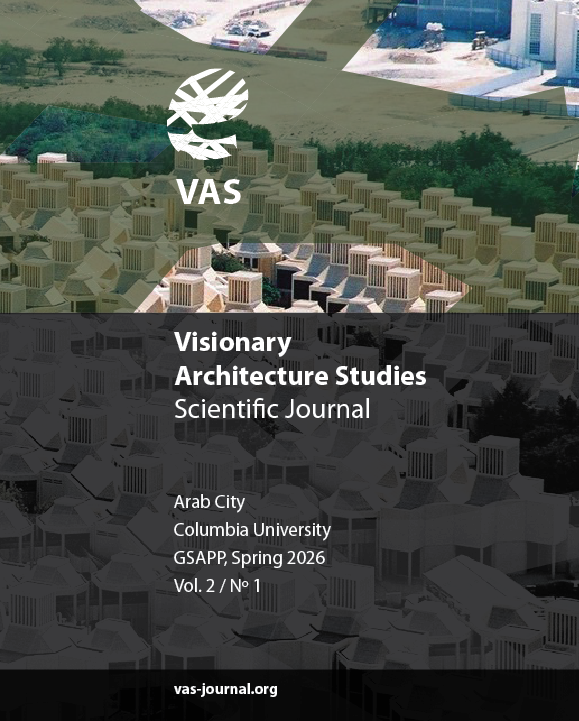
Vol. 2 No. 1 (2026): Arab City
					View Vol. 2 No. 1 (2026): Arab City

The Arab City does not exist. Yet, as an idea, it has occupied the site of endless projections—from exotic to political—which, re-examined, can enable us to better understand the region’s architectural and urban complexities, amongst other things. As a reality, the Arab City has manifested itself in varied ways across time and place. As such, it is a wonderful lens through which to understand a shared culture and people, its interconnected geography, and complex histories.

In the past decades, The Arab City has fostered a wide array of radical experiments in architecture and urbanism. From leading the wave of ‘instant urbanism’ to building the first zero carbon city, the MENA region has hosted the FIFA World Cup, witnessed a resurgence of social housing and investment in outstanding institutional buildings, public spaces, and education campuses, led major reconstruction and preservation efforts as well as re-affirmed for the world the importance of public space through ongoing civil resistance and revolutions, however brutally repressed.

Published: 2026-09-08

Articles

View All Issues


VAS - Visionary Architecture Studies, peer-reviewed Scientific Journal, emerges from 10 years of experience with the Urban Creativity conferences and publishing activities, broadening the scope of architecture studies publications.

Although the term 'visionary' in the context of architecture is not new, we identify it as a lively and dynamic field that can benefit from a dedicated regular scientific publication. Visionary architecture has a vast and long tradition and is historically an unavoidable subject of study. It is strongly connected with the daily practice of architects, artists, and activists alike.

Visionary Architecture employs a multiplicity of formats and covers a wide range of motivations. It can take the form of texts or representations, models, drawings, and images depicting imaginary worlds, cities, buildings, or undefined spaces. Often, it can be polemical, anti-systemic, political, idiosyncratic or pedagogical.

VAS includes architecture image studies and more. We intend to attract interactions between scholars and practitioners, both in visual and written formats. VA provides a platform for multidisciplinary research that transcends the traditional boundaries of architecture. It encourages contributions not only from architects and architectural historians but also from visual studies and writing scholars, photographers, artists, and others who examine the visionary aspects of architectural representation. By doing so, the journal fosters a broader discourse that enriches the field and enhances our understanding of the present and possible futures of our built environment. Visionary practices have deep cultural, historical, and contextual variations; thus, the VAS journal is dedicated to international perspectives. Our journal pretend to foster diversity and actively will seek to explore representations across different regions and traditions. Through this, we aim to create a more inclusive and holistic perspective on the practice and study of architecture. The international appeal of VA will be evident our future editorial board, which we aim to include members from near 10 countries spanning different continents. Furthermore, our journal actively will encourage contributions from authors worldwide, and our published articles consistently explore both local and global issues.

VAS online Journal it is a blind peer reviewed Open Access regular scientific publication, have English as the working language. The handling of special issues, adhere to the journal Reference Style, Editorial Procedures and Peer-Review, and Ethics. Depending on the issue the special issues could have specific scientific committee compositions.